
By Dave Ansari
When the ending of the current film and animation pipeline is discussed, discomfort is almost inevitable. Some react with resistance, others with denial, and some try to dismiss it with humor. These reactions are natural. But emotional proximity to an industry does not change the direction in which it is moving.
The world now stands at the edge of a transformation that is not incremental. It is not an upgrade. It is a collapse and a rebirth at the same time, with AI at the very center of this shift.
The Myth of the “Standard Pipeline”
For decades, film and animation followed the same sacred pipeline: modeling, rigging, animation, lighting, compositing, rendering. Entire careers were built around mastering one small piece of that chain. Software became identity. Pipelines became religion.
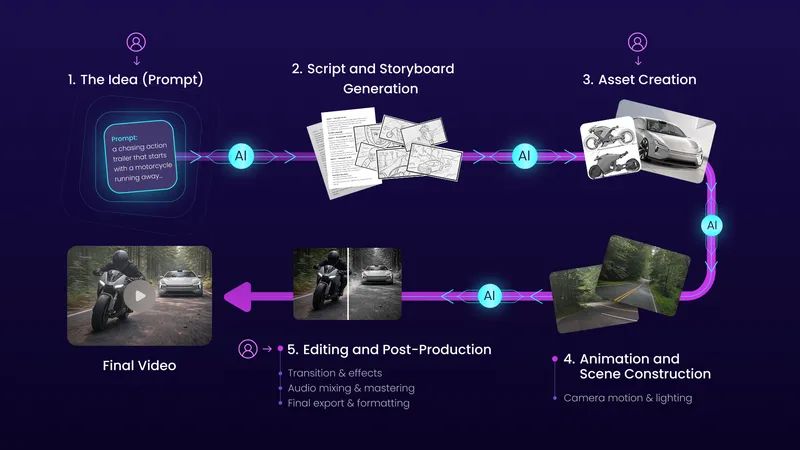
Today, that logic is quietly breaking; there is no such thing as a “standard AI pipeline.” It changes every few months. Studios are now building workflows on the fly, combining multiple AI systems into hybrid production models. What used to take large teams and long schedules can now be done by a handful of people in days. Sometimes hours.
This is not the future. This is already happening.
The Economics Are Sliding Toward Zero
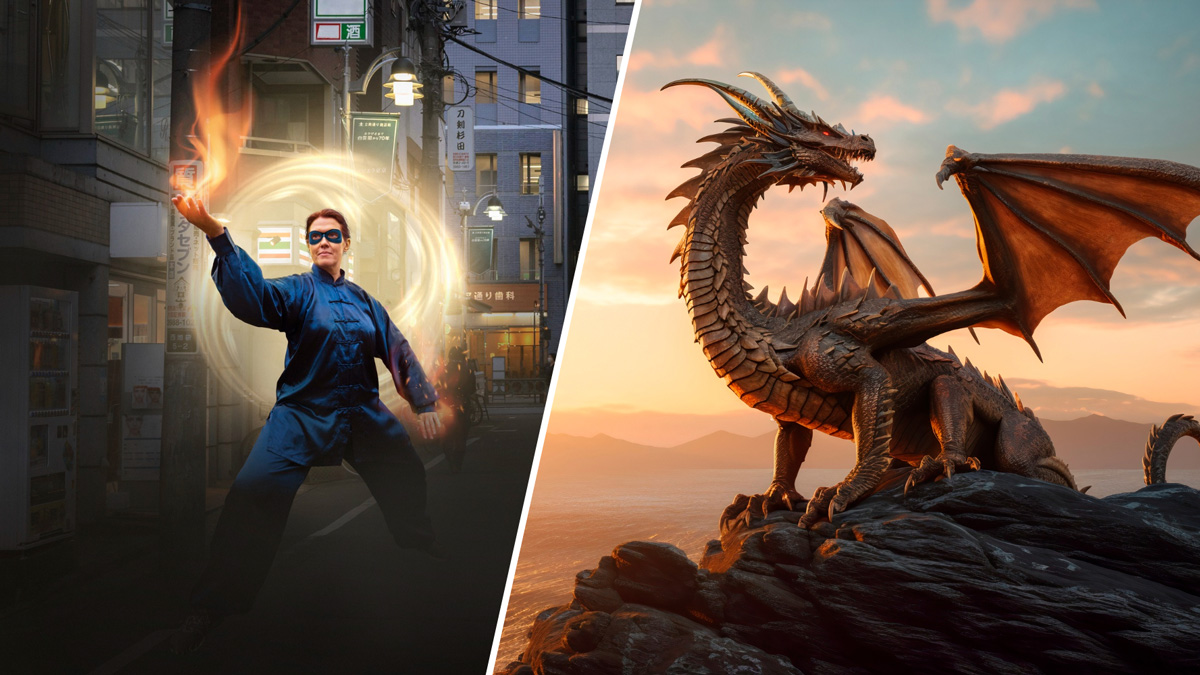
Around the world, filmmakers are already producing real films, commercials, trailers, and branded content with AI — faster, cheaper, and with far fewer people. These are not experiments. They are being published, distributed, and monetized right now.
The uncomfortable reality is that the marginal cost of producing content and IP is moving rapidly toward near-zero. When production becomes almost free, the old economic models of the industry begin to fall apart.
The costs will not disappear entirely; they will shift. Instead of spending primarily on traditional software licenses, hardware upgrades, and massive render farms, production budgets will increasingly flow toward AI engines, cloud infrastructure, and compute access.
Soon, the problem will not be how to produce. The problem will be how to matter in a world of infinite content.
The Next Layer
The conversation often gets stuck on “AI tools” inside the computer: models, prompts, render tricks. But the bigger shift is what happens when AI moves beyond screens and begins capturing real life as training data and context.
Amazon’s move in this direction is a clear signal. In July 2025, the company confirmed plans to acquire Bee, a wearable AI assistant designed to listen to and transcribe conversations, then generate summaries and to-do items, according to reports at the time.
At the same time, Amazon (AWS) has publicly committed up to $50 billion to expand AI and supercomputing infrastructure for U.S. government workloads. That is another sign of how aggressively major platforms are scaling the compute that powers these systems.
This matters for film and animation because the industry’s “reference” and “research” phase is about to be automated at scale. When AI can ingest reality continuously — speech, movement, environments, behavior — the gap between the physical world and synthetic production shrinks.
Skills, Fear, and the Psychological Wall
Most resistance to AI is not technical. It is emotional.
For many, software expertise has been the core of professional identity for decades. Now, creativity is being separated from manual execution. The bottlenecks that once defined production are dissolving, and that shift is deeply unsettling.
This does not mean creativity is dying.
It means the rules of how creativity becomes reality have changed.
Emotion, Art, and the AI Question
A common argument is that AI cannot create real art because it has no human emotion. It is true that emotion is essential to art. But it does not have to be exclusively human.
AI is already modeling emotional structure, narrative rhythm, audience reaction, and psychological response at scale. It does not feel the way humans feel, but it increasingly understands how feeling works, and can replicate emotional patterns with surprising accuracy.
This is why the debate about authenticity will get sharper, not softer. The question will shift from Can AI create? to What will people value when AI can create endlessly?
A Much Bigger Future Than We Imagine
Soon, physical robots will enter everyday life. Humans and machines together will expand far beyond Earth. At the same time, humanity likely understands less than a fraction of one percent of what actually exists.
The unknown has barely begun to inspire us.
Creativity is not shrinking.
It is about to overflow into domains we have never touched before.
More Possibility Does Not Mean More Happiness
Here is another difficult truth: AI will not automatically make humanity happier.
When everyone can create anything at almost zero cost, competition becomes extreme. Standing out becomes brutally difficult. The world will not become slower or gentler. It will become faster, louder, and more demanding.
More creators.
More tools.
More noise.
More pressure.
In that world, the “winner” isn’t always the most artistic. It is often the most optimized, the most distributed, the most adaptive.
The film and animation industry is not dying. But it is being rewritten at its deepest structural level. The traditional pipeline is fading, not because it failed, but because it belongs to a different era.
Those who accept this shift and rebuild their creative systems around AI will shape the next generation of storytelling. Those who resist will not vanish overnight, but will slowly fade out, not because AI destroyed them, but because they chose not to adapt to what was already unfolding.
The truth is uncomfortable, and it was never meant to feel safe.
DaveFounder & CEO - Dream Farm Agency