- Why Campaign-Based Branding Is Broken
- Brands Are Competing With Entertainment Now
- Traditional Brand Communication Isn't Enough
- Characters As the Core of Brand Storytelling
- Why Most Brands Fail at Storytelling
- Campaign Thinking vs System Thinking
- A Character Must Be a System, Not a Design
- Why Performance-Driven Branding Fails
- What Characters Actually Build for Brands
- How Characters Change Audience Behavior
- Characters Create Continuity
- Questions Brands Should Think About
- Start Here: Build a Character System

Dave AnsariFounder & Business Strategist 
For years, brands have been taught to work in campaigns.
So everything turns into moments. A launch. A promotion. A seasonal push. Each one gets planned, executed, measured… and then we move on to the next.
Inside a company, this actually feels good. Teams are busy, budgets are being used, and there’s always something to show as progress.
But if you step back and look at it from the outside, it tells a different story.
It doesn’t feel like momentum; it feels scattered.
You see a bunch of separate efforts, each trying to grab attention on its own, but not really connected to what came before. The message changes. The visuals change. The tone changes. What the brand said three months ago doesn’t really connect to what it’s saying now.
And in a landscape where attention is already limited, this inconsistency adds up.
Research in marketing science, particularly from the Ehrenberg-Bass Institute, shows that mental availability, how easily a brand comes to mind in buying situations, is built through repeated exposure and memory structures over time, not isolated bursts of activity.
That creates a gap.
Because people don’t remember activity. They remember patterns. And right now, most brands aren’t building one.
But what is missing? Let’s see.
Why Campaign-Based Branding Is Broken
At some point, you realize the issue is not execution. It is not better creatives, better targeting, or bigger budgets.
It is the structure itself.
Most brands are built to run campaigns, not to build identity. And those are not the same thing.
A campaign is temporary. It exists to perform in a specific window. It peaks, delivers results, and fades.
An identity accumulates. It builds over time. The longer it exists, the stronger it becomes.
This changes the core question.
Instead of asking what we launch next, the question becomes:
What are we building that will still matter in a few years?
And that shift leads directly to characters.
Brands Are Competing With Entertainment Now
Attention has changed.
Brands are no longer competing only with other brands. They are competing with creators, platforms, and entertainment that people actively choose to spend time with.
This means brands are no longer just expected to communicate.
They are expected to hold attention.
Traditional Brand Communication Is Not Enough
Traditional communication is simple:
- explain the product
- deliver a message
- highlight a benefit
But attention today is not held by explanation.
It is held by:
- curiosity
- emotion
- progression
And that comes from the story.
Not isolated messages, but something that unfolds over time.
Characters Are Becoming the Core of Brand Storytelling
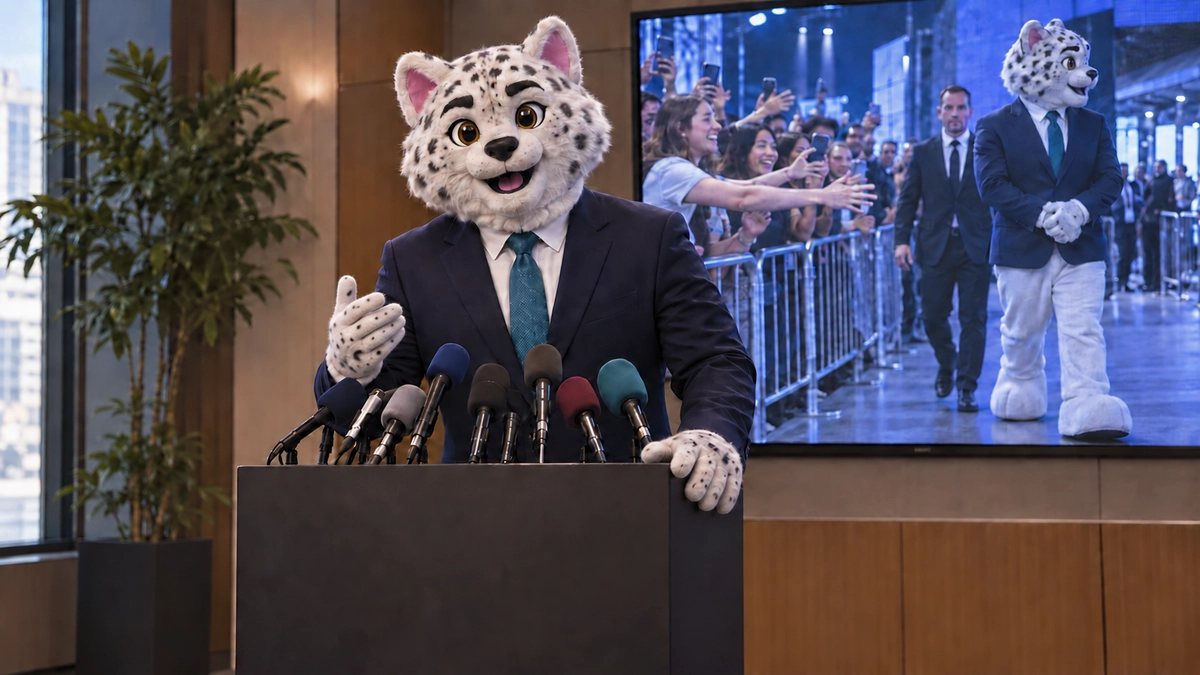
A product can be explained, but a character can be experienced.
A product can be described. A feature can be explained. But a character can actually experience things.
And through that, the brand can express a perspective, not just a message.
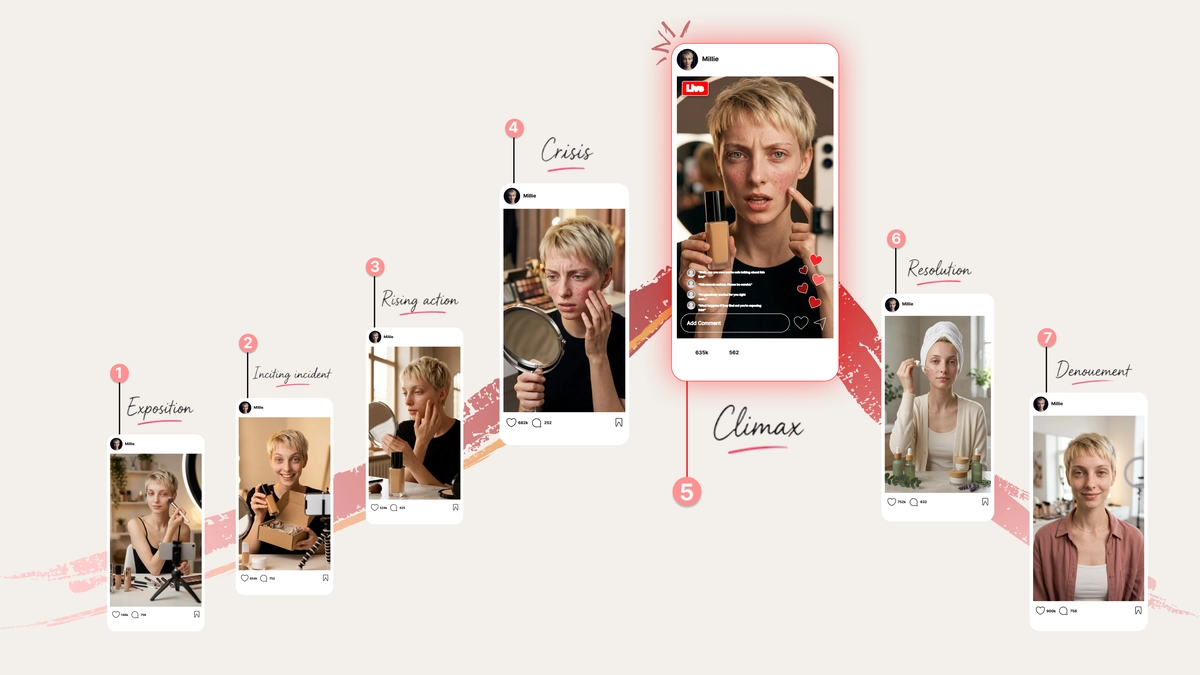
A character creates continuity.
A real character is not just a visual system. It has behavior. It reacts. It has a tone people recognize.
Over time, it starts to feel familiar. Like it existed yesterday, exists today, and will exist tomorrow.
That continuity is what makes storytelling possible.
Because stories need progression, and progression needs something to carry it forward.
A clear example is how many global brands like Nike sometimes run very different campaigns under the same brand umbrella.
For instance, Nike has built its brand around a consistent “Just Do It” identity, but over time, it has also run very different campaign directions (performance-driven, social issue-driven, athlete-focused).
This creates strong individual campaigns, but some critics point out that not every touchpoint feels like part of one continuous story unless the core narrative is very tightly maintained.
And that’s the difference between running campaigns and building something that actually evolves.
In brand strategy discussions, this is often described as a “consistency vs campaign” tension, where strong individual ads don’t always add up to a single evolving narrative unless a clear character or central storyline connects them.
Why Most Brands Fail at Storytelling
Most brands try to tell stories without a storyteller.
So every campaign starts from zero:
- a new idea
- a new tone
- a new direction
Nothing connects. Nothing builds. But when a character exists, the system changes.
The story no longer resets. It continues. The character reacts, evolves, and builds history. And the audience starts following not just content, but a journey. But when content is built around a character, it will be more scalable.
And a strong character doesn’t just shape content. It starts shaping decisions; shaping a system.
From Campaign Thinking to System Thinking in Branding
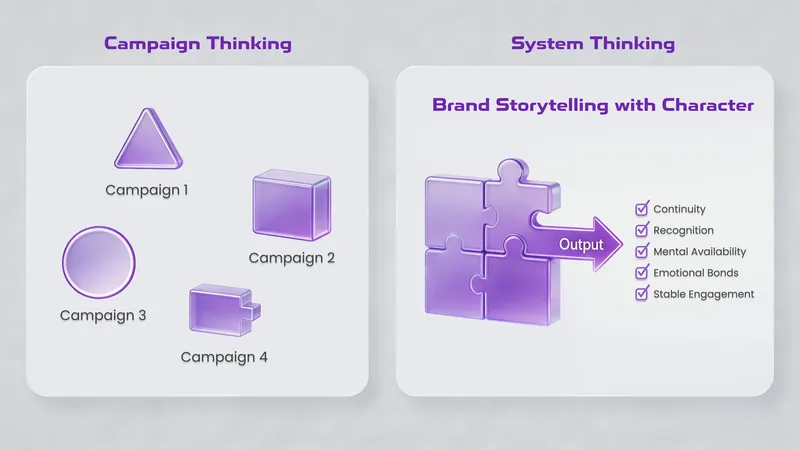
The real shift is not from no mascot to having one. It is from campaign thinking to system thinking.
From isolated messages to continuous storytelling. From renting attention to building identity.
Most brands still operate in a model where attention is bought in bursts. And it works, as long as you keep paying. But the moment you stop, it disappears.
A Character Must Be a System, Not a Design
Most brands treat characters like visuals. They create something that looks like a character, but it has no depth.
No background. No behavior. No evolution. It shows up and disappears.
That is not a character. That is decoration.
A real character includes:
- personality that drives behavior
- background that gives depth
- a story that evolves over time
At that point, it stops being an asset. It becomes a system.
The Problem With Performance-Driven Branding
Most brands today are optimized for performance, not presence. They are good at capturing attention, but not holding it.
So they produce more, push more, spend more.
But the core issue remains: attention is still rented, not owned.
Every campaign has to reintroduce the brand. Every message has to rebuild recognition.
Over time, this creates fatigue for both the brand and the audience.
What Characters Actually Build for Brands
Characters build value that compounds over time. Instead of restarting with every campaign, they create continuity, so each piece of content builds on what came before. Over time, this consistency can turn a character into a distinctive brand asset that strengthens recognition and memory.
They do this through:
- Continuity: Instead of restarting with every campaign, each piece of content builds on what came before. This creates a sense of progression rather than fragmentation.
- Recognition: A consistent tone, behavior, and perspective make the brand easier to identify without repeated explanation.
- Mental Availability: Repetition with consistency strengthens memory structures, making the brand easier to recall in decision-making moments.
- Reduced Cognitive Friction: Familiarity lowers the effort needed to process and trust the brand, making it easier for people to choose and return.
- Emotional Connection Over Time: A consistent character allows audiences to build a relationship, not just consume isolated messages.
- More Stable Engagement: Instead of short spikes, engagement becomes more predictable and sustained.
This Approach Requires a Different Mindset.
Character-driven branding operates on a different growth logic:
- Slower Initial Impact: Results don’t appear as immediate spikes because the system is still being built.
- Harder to Measure Short-Term: Traditional campaign metrics don’t fully capture long-term memory and recognition.
- Consistency Over Intensity: Ongoing presence matters more than occasional creative bursts.
- Compounding Effect Over Time: Each interaction adds to a larger system, increasing effectiveness gradually.
- Shift from Interruption to Attraction: Instead of constantly pushing for attention, the brand becomes easier to return to.
- From Reset to Accumulation: Campaigns fade. Characters build something that persists.
So the dynamic shifts. Instead of constantly pushing for attention, the brand becomes easier to come back to.
How Characters Change Audience Behavior
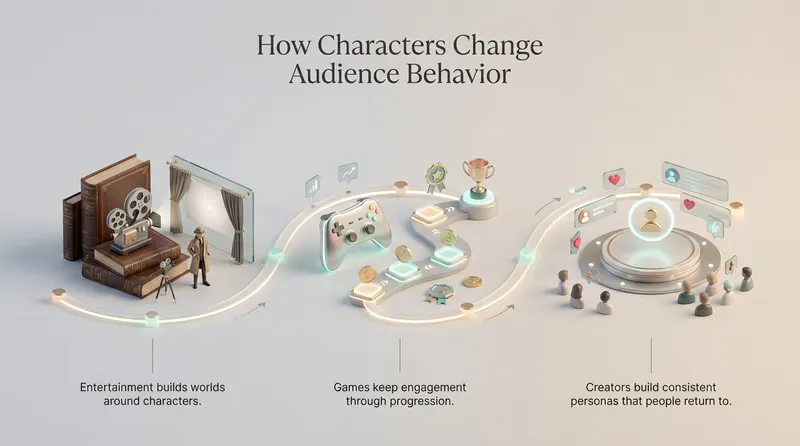
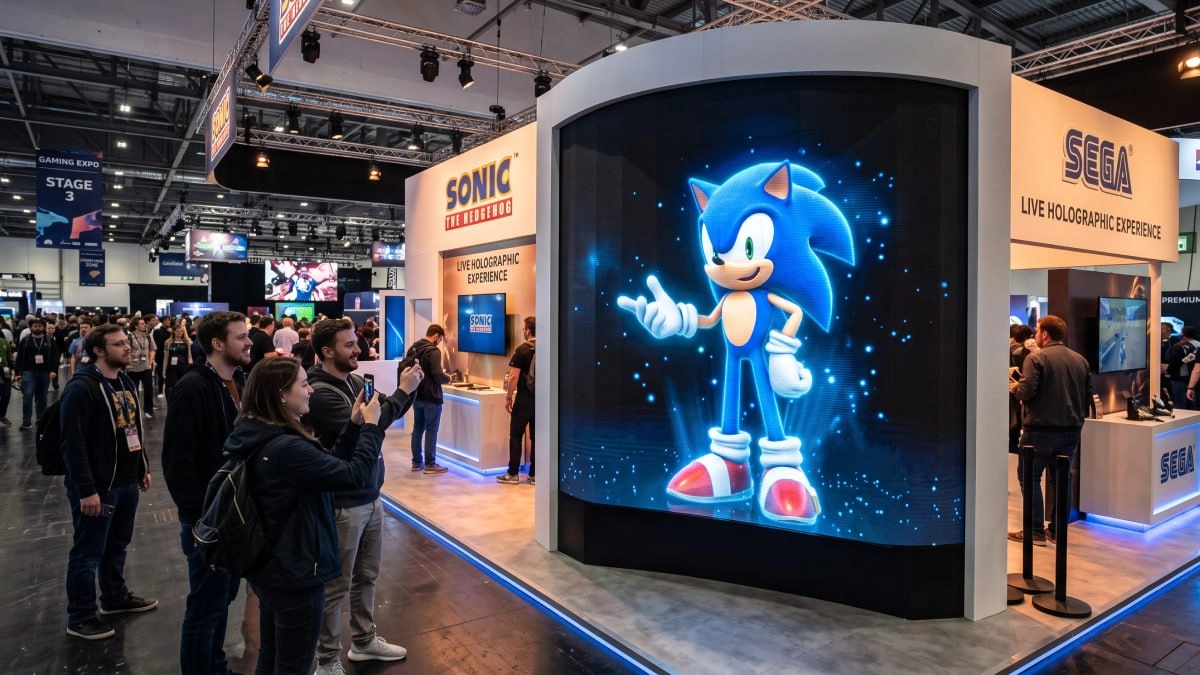
People do not follow content. They follow something they recognize.
You can already see this in other industries:
- Entertainment builds worlds around characters
- Games keep engagement through progression
- Creators build consistent personas that people return to
The pattern is simple.
Recognition creates retention.
Characters Create Continuity
Characters change this. They introduce continuity into a fragmented system.
Instead of reinventing the brand voice every time, the character becomes the voice.
Instead of asking what to say next, the question becomes:
What is the character experiencing next?
This is where content and storytelling merge. Content stops being output. It becomes part of an ongoing narrative.
And that creates anticipation.
People do not just consume. They expect. They return.
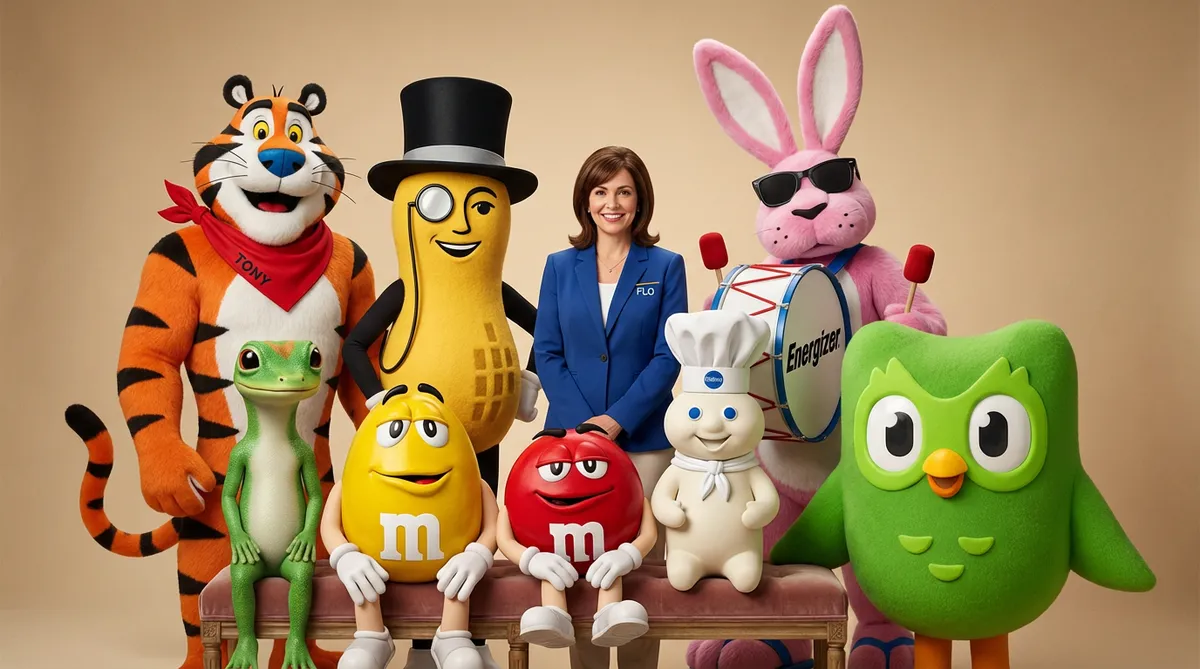
This is why Duolingo works, and most brands don’t. The character stays, the content changes.
Instead of just posting educational content about language learning, Duolingo built a consistent character around its owl mascot. Over time, that character developed a very specific personality: chaotic, funny, slightly unpredictable, and self-aware. Duolingo shows how brand mascots in marketing can create continuity beyond individual campaigns.
Because of that consistency, people don’t just follow Duolingo for language tips anymore. They follow the character.

The content itself varies, but the personality behind it stays the same. That’s what makes people stop scrolling, engage, and even wait for the next post.
And once people form that recognition, their behavior changes:
- They are more likely to engage repeatedly
- They start anticipating new content
- They share it not just for value, but for entertainment
That’s the real effect of character-driven branding.
Questions Brands Should Think About
Brands that understand this will not necessarily spend more. But they will build differently.
They will treat storytelling as an ongoing system, not a campaign tactic, and design characters as long-term carriers of identity.
And they will stop asking:
What are we launching next?
Instead, they will ask:
- What are we building that people actually want to follow?
- If your brand disappeared tomorrow, what would people actually miss?
Because attention does not follow messages, it follows stories. And stories need characters. That is why the future of branding is character-driven.
Start Here: Build a Character System
First: Don’t forget that without brand continuity, every campaign is just noise.
Second: If you’re thinking about building a character-driven brand, the starting point is simpler than it looks.
It’s not about designing a campaign or creating more content. It’s about defining a consistent presence that can carry your brand over time.
If this is something you’ve been thinking about, it might be worth having a conversation.
Dream Farm Agency’s character-driven marketing approach helps brands move from campaigns to systems, and from messages to something people can actually follow.
So let’s talk!
If that sounds relevant, feel free to reach out. You might be closer to it than you think.