
Key Takeaway
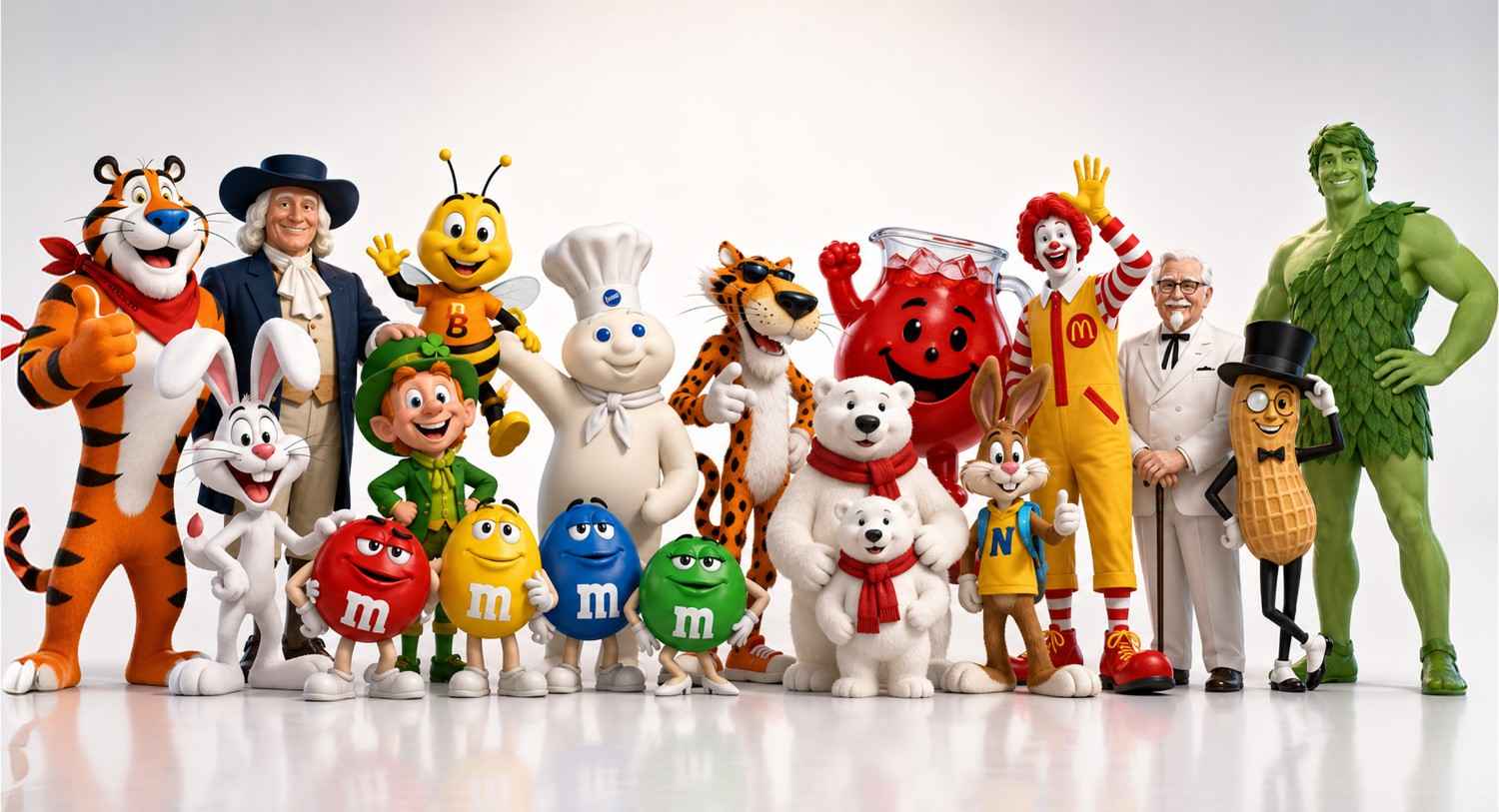
- Colonel Sanders and Tony the Tiger are two of the most famous food mascots that have been around for decades, alongside characters like Mr. Peanut and the Pillsbury Doughboy.
- Food mascots are useful because they go beyond simple packaging and help people form an emotional connection with the brand.
- Businesses in the food and beverage industry use mascots to transform mass-produced products into familiar household brands. This shifts consumer perception of the product and creates a sense of warmth and trust.
- A well-designed character can turn routine grocery purchases into emotional decision-making, which can increase sales.
- Food mascots connect to the product they represent through sensory reinforcement. They can also reflect the product’s shape to attract attention.
Brand mascots allow food and beverage businesses to stand out in crowded markets by building loyalty around the character rather than the product itself. Many well-known brand mascot examples show how a memorable character can create a strong psychological association with the food or drink it represents.
Typically, marketing food products is challenging since many food products are easy to replicate. That’s why a food mascot can give brands an advantage and create a connection that goes beyond the product.
In this blog, the main focus will be on mascots from different areas of the food industry, such as:
- Cereal and breakfast
- Snack, candy, and bakery
- Beverage and drinks
- Fast-food and restaurant
- Grocery and packaged food
We’ll also cover some of the most famous retired brand mascots to remind you that even a successful character may lose relevance over time.
Let’s begin with a table that briefly mentions all 15 mascots before exploring them in detail.
Famous Food Mascots List at a Glance
This table summarizes all 15 food mascots across different categories covered later in this guide:
|
Mascot Name |
Brand |
Food Category |
Debut Year |
|
|
1 |
Tony the Tiger | Kellogg’s Frosted Flakes | Cereal and Breakfast |
1952 |
|
2 |
The Quaker Man | Quaker Oats | Cereal and Breakfast |
1877 |
|
3 |
The Trix Rabbit | General Mills (Trix) | Cereal and Breakfast |
1959 |
|
4 |
BuzzBee | Honey Nut Cheerios | Cereal and Breakfast |
1979 |
|
5 |
Lucky the Leprechaun | Lucky Charms | Cereal and Breakfast |
1964 |
|
6 |
The Pillsbury Doughboy | Pillsbury | Snack, Candy, and Baking |
1965 |
|
7 |
The M&M’s Spokescandies | Mars Wrigley | Snack, Candy, and Baking |
1954 |
|
8 |
Chester Cheetah | Cheetos | Snack, Candy, and Baking |
1986 |
|
9 |
The Kool-Aid Man | Kool-Aid | Beverage |
1954 |
|
10 |
The Coca-Cola Polar Bears | Coca-Cola | Beverage |
1922 |
|
11 |
The Nesquik Bunny / Quicky | Nestlé Nesquik | Beverage | 1973 |
| 12 | Ronald McDonald | McDonald’s | Fast-Food and Restaurant |
1963 |
|
13 |
Colonel Sanders | KFC | Fast-Food and Restaurant | 1952 |
| 14 | Mr. Peanut | Planters | Grocery and Packaged-Food | 1916 |
| 15 | The Jolly Green Giant | Green Giant | Grocery and Packaged-Food |
1925 |
Famous Cereal and Breakfast Mascots
This section explores well-known food mascots in the cereal and breakfast sector.
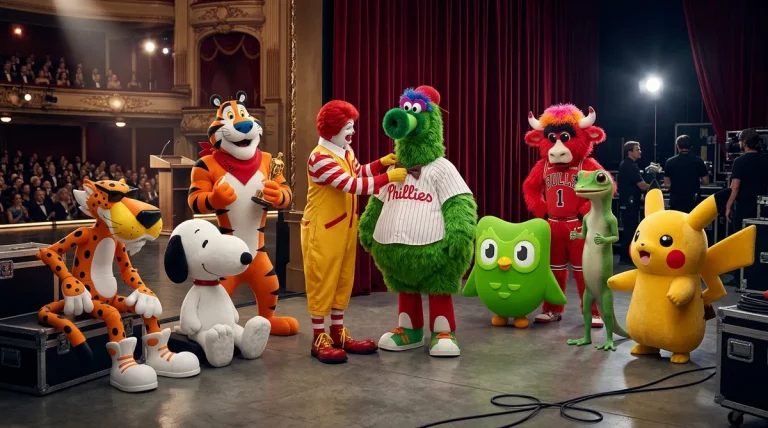
1. Tony the Tiger (Kellogg’s Frosted Flakes)
Tony the Tiger helps Kellogg’s Frosted Flakes to position breakfast as a high-performance fuel rather than a simple morning meal. This mascot, with his athletic build, represents a healthy lifestyle and gives off a sense of vitality, encouraging kids to stay active.
Although the brand’s product is a high-sugar cereal, Tony perfectly connects indulgence with a healthier image.
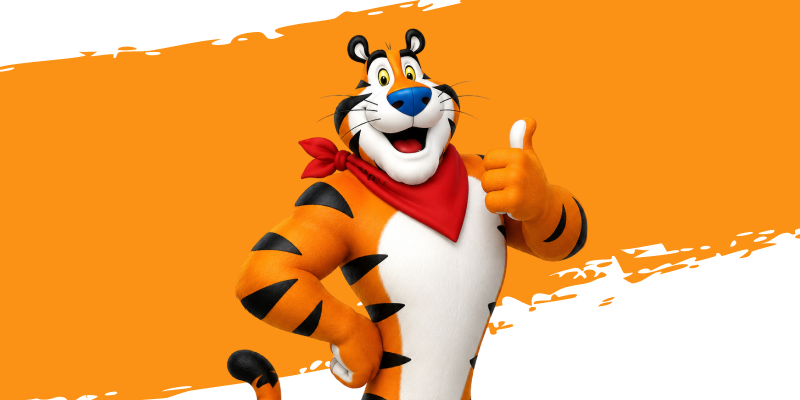
- Brand takeaway: Using a well-crafted mascot, you can reposition an ingredient via aspiration. Even food products that sit in an indulgent category can benefit from a highly active mascot to counter negative perceptions.
2. The Quaker Man (Quaker Oats)
The Quaker Man is a symbol of trust on supermarket shelves, since he’s been around for more than a century. Dressed in traditional 17th-century attire, this mascot helps move the product away from pure commodity pricing.
Back in the day, Quaker Oats used The Quaker Man as a brand ambassador to reassure shoppers about the quality and purity of the oats inside the package. At the time, nobles wore similar clothing, which explains why the character still feels trustworthy to consumers.
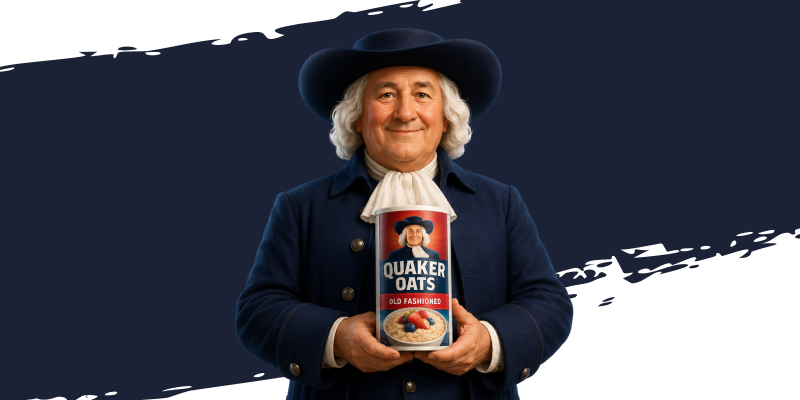
- Brand takeaway: A highly trusted mascot allows brands to go beyond bulk pricing and ask for a premium retail price based on perceived purity.
3. The Trix Rabbit (General Mills)
This cartoonish rabbit boosts product appeal for its core audience: children. The Trix Rabbit helps the brand to create a clear, psychological separation and make the food exclusive to kids only, which children love. The idea is simple:
The Trix Rabbit constantly tries to get a bowl of cereal, but the kids always refuse, repeating the famous catchphrase: Silly rabbit, Trix are for kids! The endless, failed pursuit of the multi-colored cereal frames the product as an incredibly high-value prize for children.
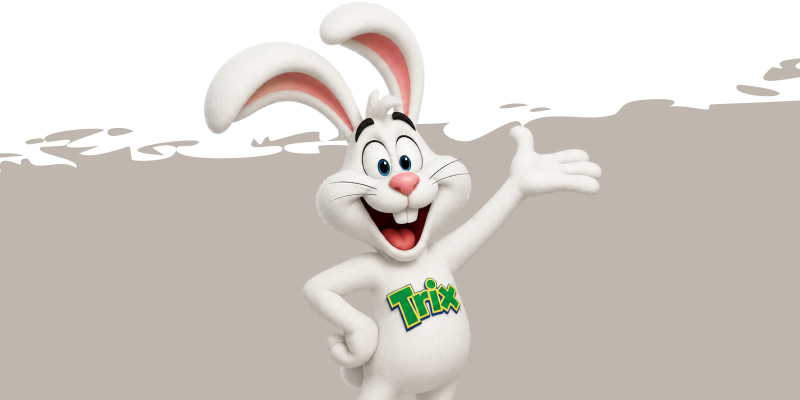
- Brand takeaway: Brands can even sacrifice and make their mascot look foolish in front of the audience in order to make the product so intensely desirable.
4. BuzzBee (Honey Nut Cheerios)
BuzzBee focuses on naturally perceived ingredients in the Honey Nut Cheerios product to make the shift from plain to sweetened cereal feel smooth.
With its sleek, anthropomorphic look, this mascot shifts attention toward honey and nuts instead of added sugar. This is how the brand reinforces ingredient credibility and reduces health concerns.
The cute bee is visually tied to the flavor and product formulation. It is a bee, so the presence of real honey feels more believable. Its warm, golden-yellow color matches the glaze on the cereal loops.
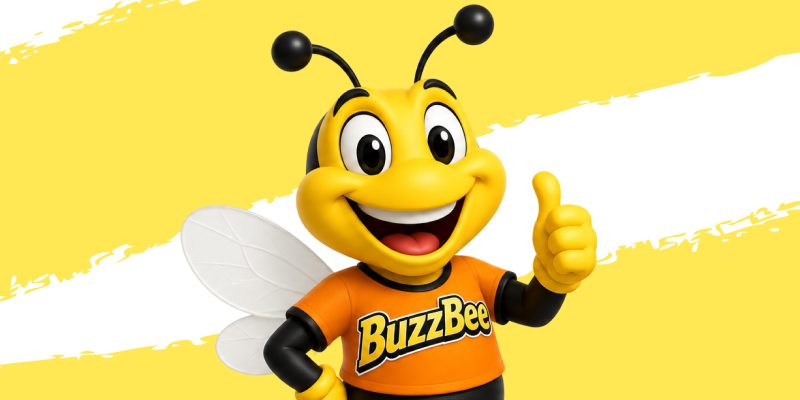
- Brand takeaway: Visualizing flavor origins through the design of the mascot helps to validate the product’s taste. If a product extension adds sweetness or flavor to a healthy baseline, a good food mascot can maintain focus on the star ingredient and reduce skepticism.
5. Lucky the Leprechaun (Lucky Charms)
With Lucky the Leprechaun, Lucky Charms makes its standard cereal feel like rare, almost magical items.
In the food industry, mixing different textures and shapes is a common approach to boost palatability, and this famous food mascot turns mixed components into an adventure built around finding special pieces.
Lucky allows the brand to easily expand its product line with new marshmallow shapes or colors. The mascot’s magical powers allow his storyline to adapt whenever Lucky Charms expands and launches different product variations.
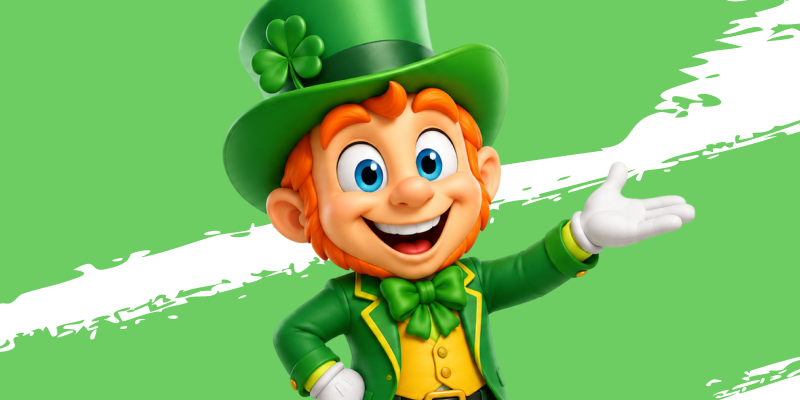
- Brand takeaway: Tying the brand’s mascot identity to the physical shape of the product makes it easier to introduce new product variations or seasonal updates without interfering with the entire brand identity. This is gamification applied to product design to make new product lines easier to launch.
Famous Snack, Candy, and Baking Mascots
These are some of the most famous food mascots in the snacks and candy niche.
6. The Pillsbury Doughboy (Pillsbury)
This mascot is an anthropomorphic dough figure wearing a chef’s hat and neckerchief. The Pillsbury Doughboy is famous for his giggles when poked in the stomach. Pillsbury uses this character to:
- Demonstrate product freshness.
- Show customers that the products are of high quality.
- Counter common negative perceptions about baked products, such as the fear of being dry or stale.
As mentioned, giggling when poked in the stomach is the mascot’s signature trait. This creates an immediate association with tactile softness and warmth that creates comfort and addresses potential concerns.
Pillsbury successfully transformed a convenient, factory-produced refrigerated food into an emotional experience of homemade baking, thanks to the mascot.
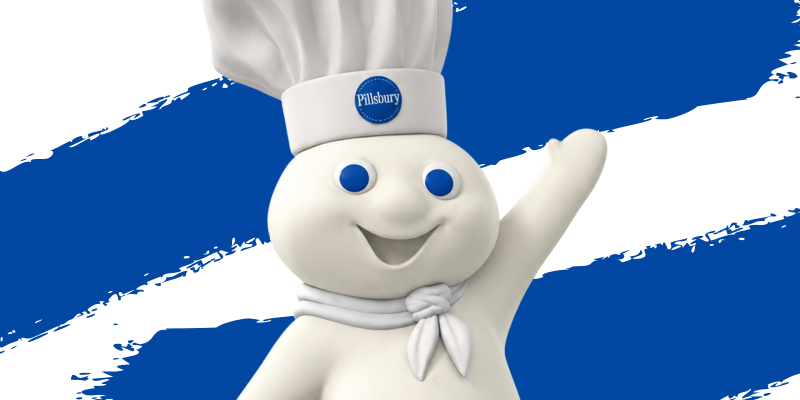
- Brand takeaway: Designing a mascot that reflects the ideal form of the product is an excellent way to personify the character. It works especially well when sales depend on product texture, similar to Pillsbury offerings.
7. The M&M’s Spokescandies (Mars Wrigley)
A group of candy-shelled chocolates, each with a distinct personality archetype. For example, the orange one is nervous and called Anxious Orange. The green one is so confident that it is named Confident Green.
These characters differentiate the various M&M flavors. Since driving repeat purchases across product variants is extremely challenging in industries like confectionery, Mars uses individual characters for each product variation, instead of treating them as separate products.
The M&M’s Spokecandies are animated versions of the food itself, and that’s how they relate to the product. Their bright, candy-coated shells also communicate the visual appeal of sweets, while each is distinguished by color.
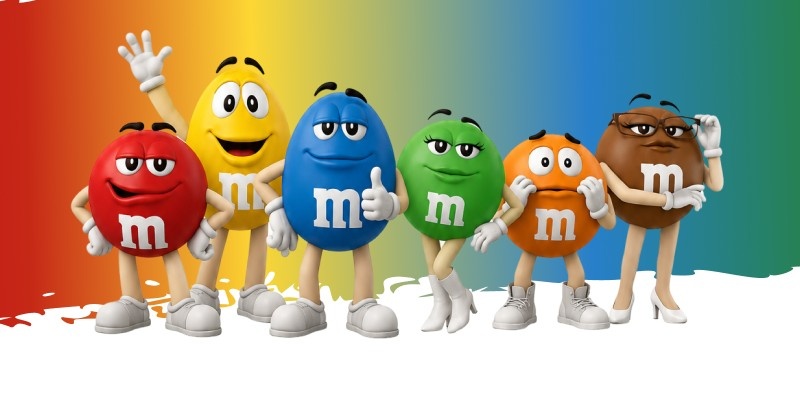
- Brand takeaway: Food brands with multiple products can use different yet similar brand mascots for each variation. Humanizing product variations using brand mascots makes cross-selling easier than ever.
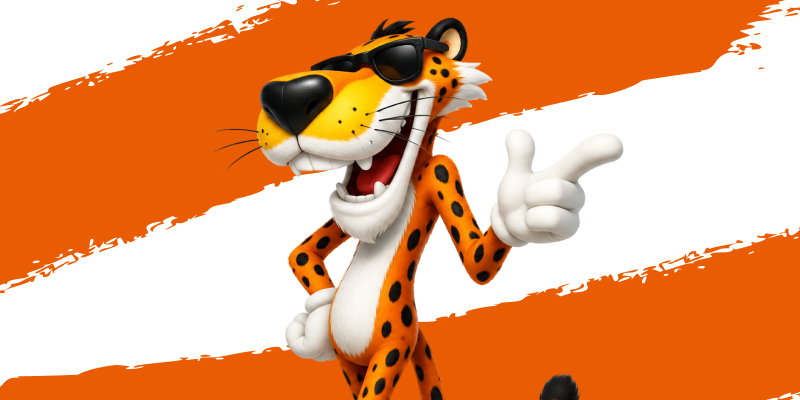
8. Chester Cheetah (Cheetos)
Cheetos’ famous mascot is a cartoon cheetah wearing sunglasses, named Chester Cheetah. He is famous worldwide, even in many developing countries.
In the food industry, snacks often drive impulse purchases through strong flavor cravings.
This food mascot embodies an obsession with the snack that turns a simple corn puff into something more exciting than an ordinary snack. The character’s design reflects what eating the product feels like. Chester Cheetah’s cool personality masks the chaos, while his orange-spotted appearance mirrors the vibrant Cheetle dust.
- Brand takeaway: Sometimes a mascot works best when it feels unpredictable. This makes people more likely to indulge and encourages impulse purchases.
Famous Beverage Mascots
Like other sectors, beverage businesses in the food industry can also benefit from an effective mascot in many ways.
9. The Kool-Aid Man (Kool-Aid)
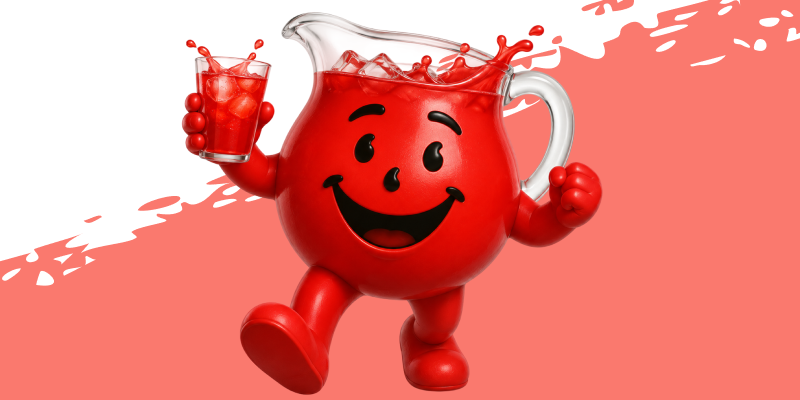
This character is a personified version of the product. The Kool-Aid Man is an oversized mascot carrying a glass pitcher filled with bright red Kool-Aid. This shows how closely the character is tied to the product. Also, let’s not overlook his famous entry catchphrase: Oh yeah!
The Kool-Aid Man works so well because:
- He crashes through walls to deliver a beverage and demonstrate the high-energy nature of the product.
- He makes preparation seem effortless.
- By turning a simple pantry staple into an exciting drink, he shifts the consumer’s focus from the preparation effort to the enjoyment of drinking it.
This famous food mascot highlights how refreshing the drink is, which is very thirst-quenching. He can also lift people’s moods with his energetic personality.
- Brand takeaway: When the product needs preparation, you can use the mascot to turn this relatively boring process into a fun, rewarding ritual and make the product more appealing.
10. The Coca-Cola Polar Bears (Coca-Cola)
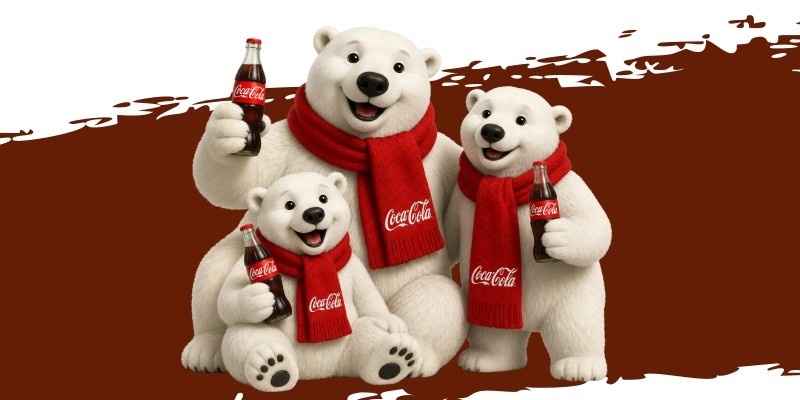
Coca-Cola uses a family of realistic animated CGI polar bears in the Arctic wilderness as mascots, who share and enjoy this brand’s products. The Coca-Cola Polar Bears help the brand avoid competing on taste and price, and instead, focus on universal human values, such as:
- Family connection
- Harmony
- Joy of being together
- Ice-cold refreshment
How do they relate to Coca-Cola’s drinks? Simply by visualizing the product’s ideal serving state: very cold.
When people see polar bears, they naturally associate them with cold environments, and this is how this group of mascots allows the brand to reinforce the concept of an ice-cold drink and pure hydration.
- Brand takeaway: It’s a good idea to place the mascot in a natural environment when selling a product that relies on temperature perception. By doing this, brands can mirror the customer’s sensory experience when using the product.
11. The Nesquik Bunny / Quicky (Nestlé Nesquik)
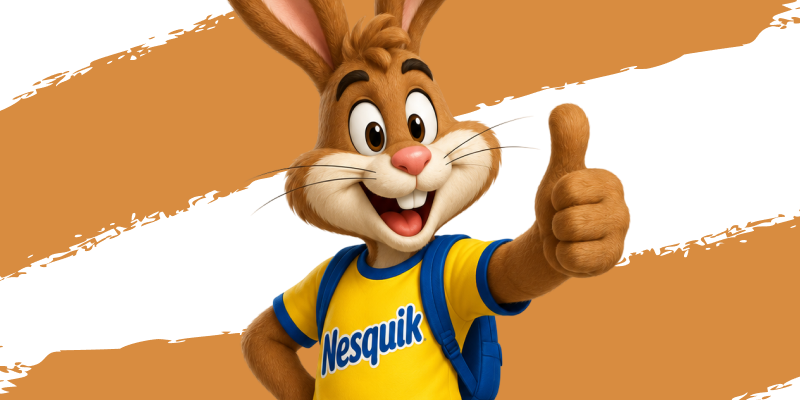
Some call it the Nesquik Bunny, others call it Quicky. It’s the Nestlé Nesquik mascot, another entry on this blog’s food mascot list. An energetic, sleek cartoon rabbit who wears a blue N logo and shows his strong love for milk flavoring, the brand’s product.
With Quicky, Nestlé Nesquik shows it cares about both parents’ nutritional expectations and children’s taste preferences simultaneously. This rabbit shows kids that milk can taste good with added flavor, and drinking it daily doesn’t have to be a daily chore they don’t enjoy. The mascot is tied directly to the product’s functional attribute, which is speed, by his name and personality.
The Nesquik Bunny demonstrates how quickly children can transform plain milk into a rich, chocolate beverage by simply dissolving the powder. The character’s brown fur mirrors chocolate syrup, reinforcing that the outcome will be a chocolate-flavored drink.
- Brand takeaway: Food items that are meant to act as a companion or enhancer can benefit from mascots that celebrate the transformation process. Nestlé Nesquik took this approach and made the final preparation step look not only effortless, but desirable too.
Famous Fast-Food and Restaurant Mascots
These two characters are widely known beyond the food industry.
12. Ronald McDonald (McDonald’s)
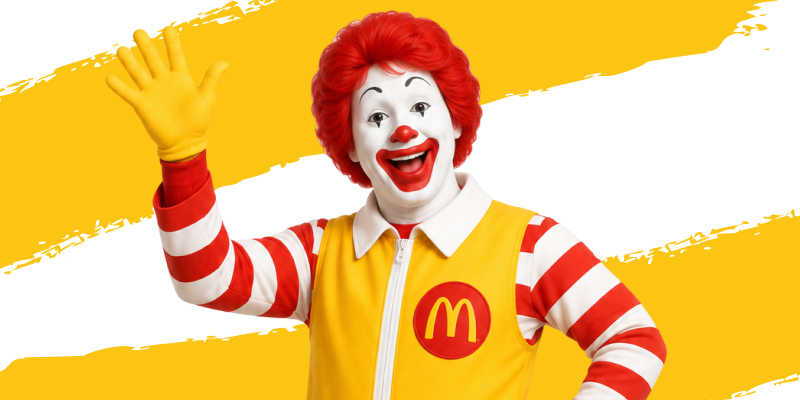
The world’s largest fast-food chain uses a brightly colored clown to visualize the charming feeling of eating McDonald’s food. Ronald McDonald acts as a symbol of family-friendly hospitality across generations.
Although food is highly commoditized in QSR (Quick Service Restaurant) and can be easily replicated, McDonald’s managed to transform simple dining into experiential family hubs with this mascot.
A key success factor for Ronald is that he doesn’t promote a single item on the menu. Instead, Ronald reflects the concept of the Happy Meal and the playground experience.
The bright yellow and red attire he wears directly mirrors the brand and McDonald’s signature color psychology.
- Brand takeaway: Competitors may replicate how your food tastes, but they’re less likely to convey the feel of your brand. So, use a mascot to build a strong emotional connection around the brand.
13. Colonel Sanders (KFC)
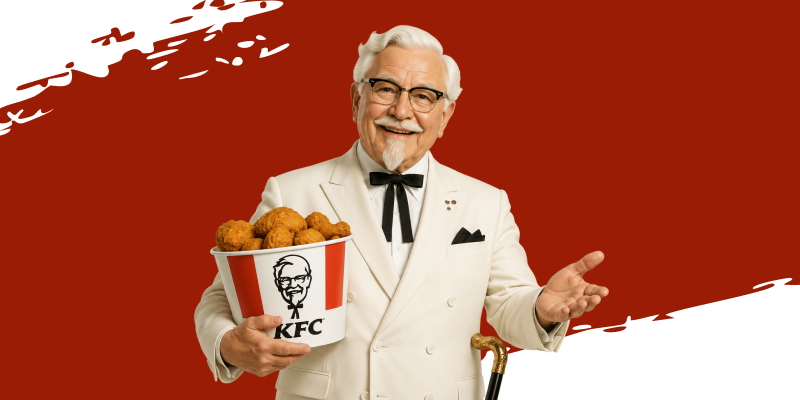
Colonel Sanders is directly tied to the KFC fast-food chain, as he is the real founder of the brand, and his story is widely known. He is recognizable enough to function as both mascot and logo at the same time. Read more about it in “Mascot vs. Logo: When to Keep Them Separate (and When Not To).”
When people see Haland Sanders’ smiling face, they feel assured about quality. This food mascot is able to maintain a sense of authentic cooking quality across thousands of global branches, which is difficult to achieve at scale. In fact, Colonel represents the idea that the food is prepared according to the brand’s high standards, using premium ingredients.
His grandfatherly appearance makes people associate the meal with slow-cooked, homemade comfort, rather than typical fast food.
- Brand takeaway: Consider using the brand’s founder as the brand’s mascot to emphasize specific traditions and proprietary recipes. This increases trust and authority in an effective way.
Famous Grocery and Packaged-Food Mascots
The last two famous food mascots on our list are:
14. Mr. Peanut (Planters)
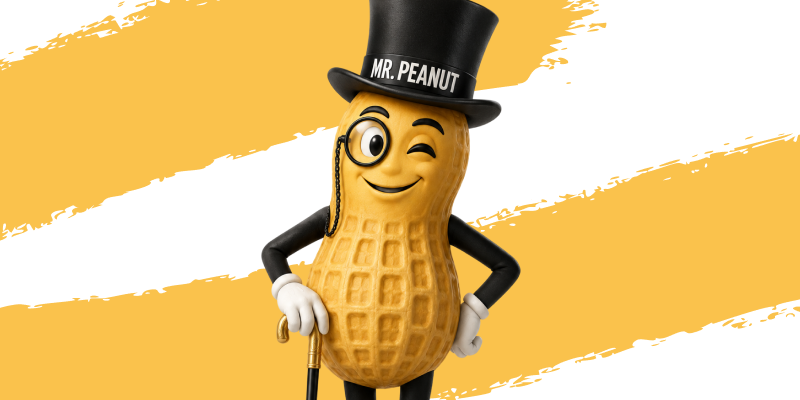
Mr. Peanut, the mascot of Planters, is a peanut, as the name suggests, with the following traits:
- Anthropomorphic
- Dressed in a top hat and white spats
- Has a monocle in his left eye
- Uses a cane
This elegant mascot is designed to radiate upper-class sophistication. That said, Planters uses Mr.Peanut to give its products a premium image. Historically, raw peanuts were treated as a cheap commodity that was usually sold in bulk. Mr. Peanut was able to alter this perception, turning a simple agricultural product into a superior cocktail snack.
The character humanizes the product. His fancy appearance suggests quality and attention to detail that appeals to premium consumers.
- Brand takeaway: Even inherently cheap products can be upscaled with a distinguished mascot. If designed properly, a good character can completely change the narrative of the product’s economic value and enable premium pricing.
15. The Jolly Green Giant (Green Giant)
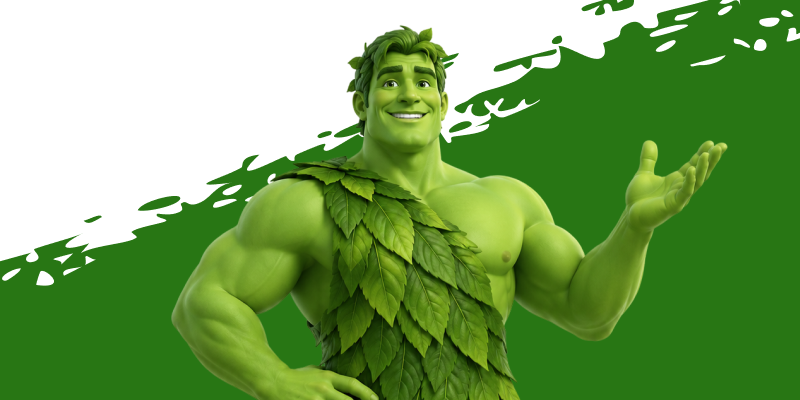
The Jolly Green Giant is a friendly giant made of foliage. He oversees ‘The Valley’ and protects the crop fields. This mascot helps Green Giant reassure customers about quality.
In general, people are skeptical of canned or frozen vegetables, questioning their freshness and flavor. Green Giant addressed these concerns using a well-crafted mascot that has become a symbol of trust and seasonal abundance. It feels reassuring knowing a giant is watching over everything.
This giant is green, so he represents agricultural health and vitality. Jolly’s presence suggests that the vegetables are grown and harvested under his careful supervision.
Also, he has a simple but memorable catchphrase: Ho, Ho, Ho! This is how he tells shoppers that the frozen or canned contents are field-fresh.
- Brand takeaway: With a mascot rooted in nature, you can distract consumers from industrial packaging and shift their focus to farm-to-table freshness. This tactic is especially useful for frozen or canned food like Green Giant products.
Two Rising Food Mascots Worth Watching
Unlike famous mascots with decades of history, these two mascots were created recently.
- Strawberry (The Edible Pop-Tarts Mascot – 2023)
Pop-Tarts introduced this mascot in 2023 at the inaugural Pop-Tarts Bowl. It became a notable character because of its self-aware, absurd internet humor, which resonates with younger audiences.
Strawberry introduced a different approach to modern marketing by demonstrating that its life goal is to be toasted and eaten by a winning college football team. This approach was completely different from using a person in a suit waving from the sidelines.
The result was excellent. Strawberry generated massive viral engagement across social media. Buying a snack became a fun, serialized story, instead of being merely transactional. The key takeaway of this mascot is that it proves that many modern consumers usually prefer brands that don’t take themselves too seriously.
- Spud (McCain Foods – 2024)
MacCain Superfries created this mascot in 2024 to combat digital ad fatigue. Spud helped the brand stand out at live events with its oversized shape and hyper-energetic character.
Beyond that, the mascot has a rich backstory and distinct personality traits that help represent different frozen fry products more effectively. The brand understands that it needs a fresh character to create memorable moments across TV and stadium appearances. So, they developed Spud with recurring jokes and motivations.
How We Selected These Famous Food Mascots
Dream Farm is a character-driven marketing agency helping brands create stronger differentiation, more meaningful audience relationships, and more memorable communication through the power of characters. We turn mascots, virtual characters, and AI influencers into ownable assets that support branding, marketing, storytelling, and long-term brand value.
For this blog, we asked our experts to help us identify the key criteria for selecting famous mascots that made a lasting impact on the food market.
As a result, all reviewed characters, from famous cereal mascots to grocery and packaged-food mascots, were selected according to the following factors.
Note: What you read in this blog is a curated list and not a scientifically measured popularity ranking.
Brand Recognition
This factor plays a major role in food and beverage purchasing decisions. A food product has only a few seconds to capture attention on crowded shelves, and high brand recognition helps draw it.
The mascots featured in this blog act as visual shortcuts that immediately remind people of the brand. As a result, standing out on the shelf and holding on to market share becomes easier.
Longevity
A successful food mascot must remain relevant despite changing consumer preferences over decades. Chester Cheetah is the youngest character on our list, yet he has been around for more than 40 years.
This proves that longevity is the true test of a food mascot’s economic value. Such mascots enable brands to capture children’s attention and keep them as customers into adulthood.
Strength of Association With the Product
The most effective food mascots are inseparable from the product and function as:
- A stand-in for the product itself
- A reflection of the product’s form
- A symbol of the product’s flavor
- A clear embodiment of the food from the customer’s perspective
Simply put, a food mascot serves best when it’s structurally integrated into the product’s identity, like Mr. Peanut for Planters and all the other 14 characters on the list.
With this strong mental connection, brands can stay top of mind and ensure that when a consumer craves their type of offering, they instantly think of their product.
Distinctive Character Design
Uniqueness is the next factor we used to select entries for this list. To build strong emotional branding in high-volume food retail, a distinctive character design is essential.
Mascot’s physical attributes, such as line weights and facial features, must be designed to trigger specific perceptions. For example, the giant size of Green Giant signals product quality, while the sharp, angular design of The Trix Rabbit communicates high energy.
Read more: “The Psychology of Brand Mascots: Designing Characters That Influence Behavior”
Influence on Food Advertising
Each of the mentioned mascots has reshaped food advertising in its own way.
In the past, promoting food was focused mainly on ingredients and product weight. Food mascots helped brands revolutionize this space with narrative-driven marketing and memorable catchphrases, such as Kool-Aid’s ‘Oh yeah!’ catchphrase.
It’s safe to say that popular food mascots shift food advertising from selling a product to telling an ongoing story. Food leaders realized that humanized characters improve marketing ROI and build long-term customer interest.
Cultural Relevance
Food mascots lose impact when they’re not culturally relevant to the brand. When the character clearly reflects the brand’s origins and core values, it goes beyond being just a logo or mascot. Instead, it becomes an asset that can represent the business across:
- TV shows and programs
- Digital media
- Different art forms
- Print ads
- Metaverse
This creates major economic advantages for food and beverage brands. For example, it paves the way for earning millions in organic media coverage, which is usually difficult to achieve with paid advertising campaigns.
How Food Mascots Influence the Buying Experience
Marketing food is different from other product categories, since food purchases are rarely fully rational. Food products are easy to replicate, so food brands must invest in split-second subconscious cues to stand out in this competitive industry.
That’s why food mascots need to influence how consumers make buying decisions.
In this section, we’ll discuss three key capabilities of successful food mascots.
1. Improving Brand Recognition and Product Choice
Have you ever felt overwhelmed by too many product choices? This is especially common in crowded markets, like the food industry, where products often have many similar competitors. A good brand mascot that serves as a visual anchor can reduce this feeling of fatigue.
Consumers may spend less time comparing ingredients or prices when they already recognize and trust the mascot. This can increase purchase likelihood and support higher sales.
2. Building Trust Through Eye Contact
Mascot placement on packaging also matters when trying to influence buying decisions. Character eye contact is a proven design strategy that creates an immediate connection with shoppers.
In one study published in Environment and Behavior, a cereal package featuring direct mascot eye contact received trust ratings about 16% higher than the comparison version.
Here’s how it works for different audiences:
- Children’s products: Mascots designed for children can be angled slightly downward to better align with a child’s eye level. This ensures that the mascot on the packaging makes direct eye contact with children looking up at the product on the shelf.
- Adult products: Here, a mascot that can meet the horizontal eye level of adult shoppers may work better.
3. Creating Emotional Connections and Brand Loyalty
Well-designed mascots can build customer loyalty. Typically, it’s hard for people to form a relationship with a static product like a bag of chips. Brand fandom is how mascots address this. Here’s how it works:
Since people rarely become loyal to food products themselves, mascots act as a focal point for emotional attachment. A study published on Zenodo supports the idea.
This creates a repeat-buying loop:
Customers become loyal fans because of the brand mascot, so they may be less likely to switch to competing products when the differences in price and quality are small, which can increase sales.
Famous, Retired, and Controversial Food Mascots
Despite the long-standing success of many food mascots that have been active for a long time, some of the characters were forced to be retired due to major cultural shifts or public backlash:
- Aunt Jemima (Quaker Oats / PepsiCo): This character debuted in 1889, and although she was famous for many years, she was retired due to her association with racist ‘Mammy’ stereotypes from the post–Civil War era.
- Uncle Ben (Mars Wrigley): Just like Aunt Jemima, Uncle Ben was a controversial character who was no longer aligned with modern social and ethical standards. For that reason, Mars retired him and renamed the product Ben’s Original.
- The Land O’Lakes Maiden / Mia (Land O’Lakes): Mia was a Native American maiden that Land O’Lakes used for nearly a century to signal natural agricultural origins. Ultimately, she retired after criticism from Native American advocacy groups.
- Gidget the Taco Bell Chihuahua (Taco Bell): This character was successful in terms of numbers but faced backlash from Hispanic advocacy groups, leading Taco Bell to retire her.
- The Noid (Domino’s Pizza): This case is unusual. The Noid was a villain dressed in a rabbit suit, ruining pizzas before delivery. The problem was that a mentally ill person named Kenneth Lamar Noid believed TV commercials were mocking him, so he decided to hold workers hostage in a Domino’s outlet. Eventually, Domino’s Pizza had no choice but to retire The Noid in 1989.
- Mac Tonight (McDonald’s): McDonald’s used this mascot and its songs for nearly three years to boost late-night sales. Everything was going well until a singer named Bobby Darin sued the brand because of plagiarism. Shortly after, Mac Tonight was discontinued.
- The “Creepy” King (Burger King): This mascot was the exact opposite of a beneficial brand character. Although designed to grab attention with his bizarre humor, The Creepy King quickly became a joke, causing the brand to end the campaign.
Why Professional Mascot Creation Matters
Professional brand mascot design and development is a specialized process, especially when creating a food mascot. As you’ve seen throughout this blog, brands in the food and beverage industry can use mascots to build stronger connections and improve recognition.
Creating a successful mascot requires a combination of creativity and a deep understanding of the brand’s audience. Also, a well-crafted strategy is essential.
Dream Farm Agency helps brands create memorable characters, from traditional mascots to virtual characters and AI influencers. Contact us to learn how a character-driven approach can help your brand stand out.
FAQ
What are the most popular cereal mascots?
Tony the Tiger (Kellogg’s Frosted Flakes) and Lucky the Leprechaun (Lucky Charms) consistently rank as the most universally recognized figures in the breakfast aisle. They are closely followed by other cultural heavyweights like Cap’n Crunch and Toucan Sam (Froot Loops).
What food mascots are based on the product itself?
The M&M’s Spokescandies and the Kool-Aid Man are prime examples in which the character is a literal, animated manifestation of the food item. Similarly, Mr. Peanut from Planters uses the structural anatomy of a whole peanut to form the mascot’s physical body.
What food brands use animal mascots?
Kellogg’s relies heavily on animal ambassadors like Tony the Tiger and Toucan Sam to drive sensory and energy-based branding. Other massive CPG giants utilizing this strategy include Nestlé with the Nesquik Bunny (Quicky) and Cheetos with Chester Cheetah.
Is a founder character considered a mascot?
Yes, when a real founder’s likeness is stylized or performatively brought to life in marketing campaigns, they function exactly as a corporate mascot. Colonel Sanders for KFC and Chef Boyardee are classic examples of this case.
Which food mascots have been retired?
Major brands have retired historic characters like Aunt Jemima, Uncle Ben, and the Land O’Lakes Maiden to eliminate outdated cultural and racial tropes from their modern corporate identities.


Post Comments
0 comments